

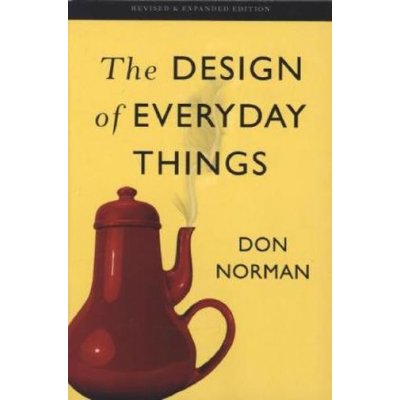
Design doesn't have to complicated, which is why this guide to human-centered design shows that usability is just as important as aesthetics. Even the smartest among us can feel inept as we fail to figure out which light switch or oven burner to turn on, or whether to push, pull, or slide a door. The fault, argues this ingenious -- even liberating -- book, lies not in ourselves, but in product design that ignores the needs of users and the principles of cognitive psychology. The problems range... Celý popis
Koupit za 356 Kč- Od nejoblíbenějších
- Od nejlevnějších
- Od nejdražších
 30 %
30 %
The Design of Everyday Things - Donald A. Norman
Doprava:
99 Kč
Skladem
356 Kč
Koupit za 356 Kč
 80 %
80 %
The Design of Everyday Things
Doprava:
53 Kč
334 Kč
Koupit za 334 Kč
 90 %
90 %
The Design of Everyday Things
Doprava:
53 Kč
334 Kč
Koupit za 334 Kč
 75 %
75 %
The Design of Everyday Things (Donald Arthur Norman)(Brožovaná)
Doprava:
39 Kč
324 Kč
Koupit za 324 Kč
Popis
Design doesn't have to complicated, which is why this guide to human-centered design shows that usability is just as important as aesthetics.
Even the smartest among us can feel inept as we fail to figure out which light switch or oven burner to turn on, or whether to push, pull, or slide a door.
The fault, argues this ingenious -- even liberating -- book, lies not in ourselves, but in product design that ignores the needs of users and the principles of cognitive psychology. The problems range from ambiguous and hidden controls to arbitrary relationships between controls and functions, coupled with a lack of feedback or other assistance and unreasonable demands on memorization.
The Design of Everyday Things shows that good, usable design is possible. The rules are simple: make things visible, exploit natural relationships that couple function and control,
Even the smartest among us can feel inept as we fail to figure out which light switch or oven burner to turn on, or whether to push, pull, or slide a door.
The fault, argues this ingenious -- even liberating -- book, lies not in ourselves, but in product design that ignores the needs of users and the principles of cognitive psychology. The problems range from ambiguous and hidden controls to arbitrary relationships between controls and functions, coupled with a lack of feedback or other assistance and unreasonable demands on memorization.
The Design of Everyday Things shows that good, usable design is possible. The rules are simple: make things visible, exploit natural relationships that couple function and control,



Parametry
| Výrobce | Perseus Books |
| Nakladatelství | TBS |